Every winter, Jewish families around the world gather to celebrate a festival of light, hope, and miracles — the holiday of Hanukkah! Hanukkah is filled with centuries-old traditions, including fried food, chocolate coins, festive songs, fun games, and candles…lots of candles! The eight nights of Hanukkah represent the eight days a single day’s supply of the Temple’s oil miraculously burned. In honor of those eight days, here are eight traditions that make Hanukkah so special for Jewish students at Sacred Heart!
- Fried Foods
During the nights of Hanukkah, it is a tradition to eat fried foods, specifically fried pancakes; in Yiddish, they are called “latkes.” Celebrants eat fried foods to commemorate the miracle of the Temple’s oil. Abby Gruber ‘26 says, “My favorite Hanukkah food is latkes drenched in applesauce.” Latkes are the most traditional fried food to eat on Hanukkah. One of Eitan Malka’s ‘26 favorite Hanukkah traditions is cooking them with his mom, a popular tradition among many families because it is a time to come together, share stories, and celebrate the holiday. The smell of frying potatoes fills the house and brings everyone together.
- Presents
Especially in America, exchanging presents has become a Hanukkah tradition. Families celebrate this in different ways. Some give gifts each night, while others exchange all their presents on one special night. “When I was younger, my parents would hide all of our gifts on the first night, and my siblings and I would find them and open them all,” says Meital Malka ‘28.
- Dreidel
Meital Malka ‘28 says, “My family has a dreidel competition every night of Hanukkah. Each night we see if we can do better than the last.” Playing the dreidel game is a Hanukkah must, bringing families together for some friendly spinning and sweet prizes. A dreidel is a small four-sided spinning top used to play a traditional Hanukkah game. Each side has a Hebrew letter that stands for a different action in the game. You spin the dreidel and, in one version, can either land on “Gimel” (get all of the prize in the pot), “Hey” (get half), “Nun” (get nothing), and Shin (put one in). Whoever ends with the most wins the game. Another way people play dreidel is by seeing who can spin it the longest, turning it into a friendly competition.
- Gelt
Gelt means “money” or “gold” in Yiddish. People give gelt on Hanukkah to celebrate the victory of the Maccabees and their creation of their own coins. Gelt is also used when playing the dreidel game. Most people today play with chocolate gelt!
- Menorahs
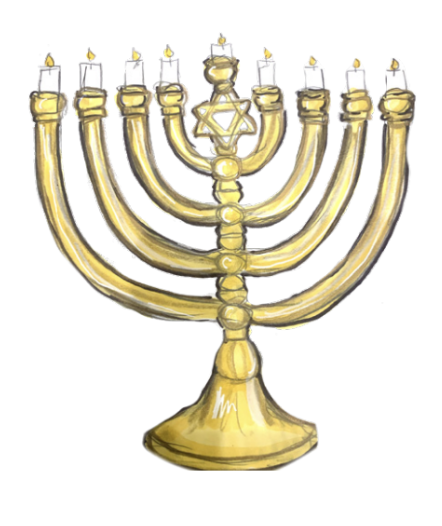
Gruber shares, “My family has a menorah that I made when I was younger, out of screws! We also have a fancy menorah.” Menorahs are a very important part of Hanukkah. Each night, people light a candle to represent each day of Hanukkah and let the candles burn out completely to commemorate the Hanukkah miracle. Every family has different menorahs; some have menorahs passed down from their family, or others have made their own.
- The Blessings
Every night before lighting the menorah, families sing a blessing over the candles and a blessing thanking God for the miracles done for their ancestors. Additionally, on the first night of Hanukkah, people sing special blessings giving thanks to God for allowing us to reach this season.
- Songs
Hanukkah songs are especially fun for younger kids to sing. Popular favorites include “I Have a Little Dreidel” and “Hanukkah, Oh Hanukkah,” a traditional Yiddish folk song transcribed into English by Mordkhe Rivesman.
- Mensch on the Bench
The Mensch on the Bench is a newer addition to Hanukkah traditions. Similar to the Elf on the Shelf, families hide the Mensch and his bench or use them as decorations. The word mensch is Yiddish for a person of good character, integrity, and honor. It’s a fun way for families to celebrate Hanukkah and add a little extra holiday spirit.