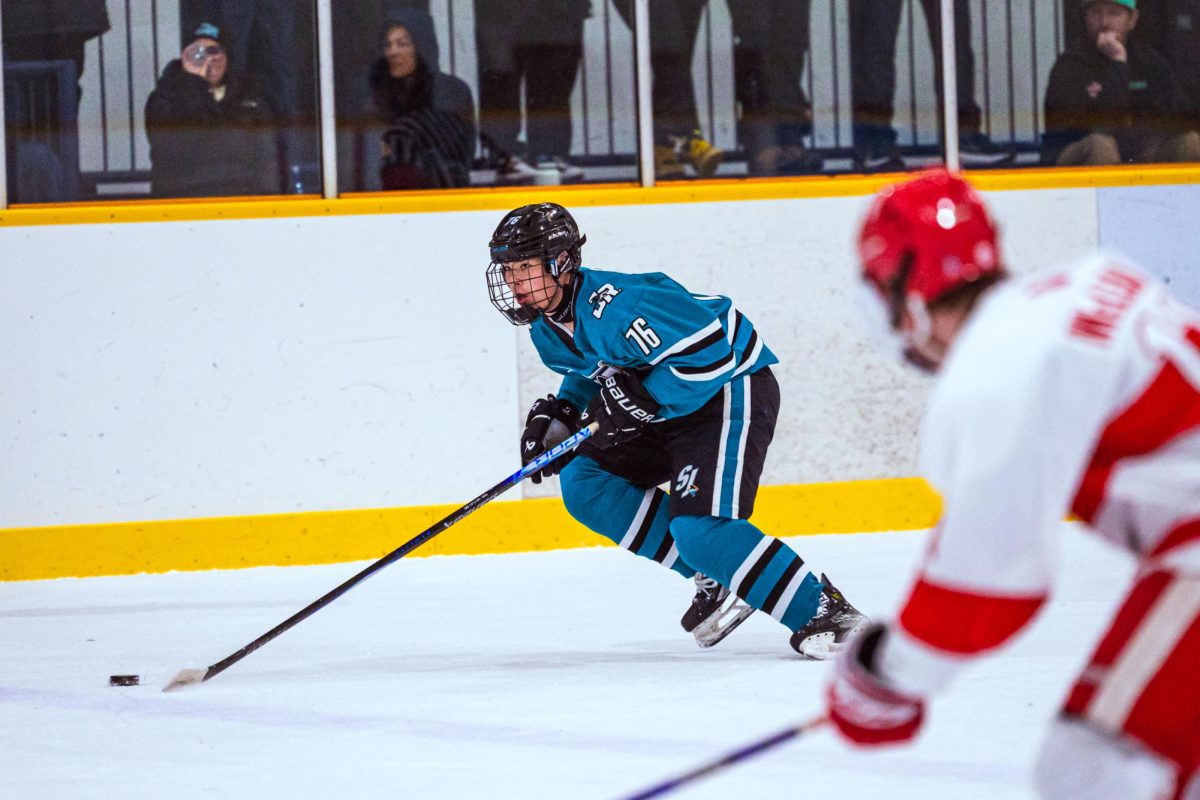
When you think of athletes at Sacred Heart, your mind probably goes to football, basketball, water polo, or lacrosse. But at SHP, a new sport has been gaining popularity: hockey. This article covers five different hockey players at SHP: Quincey Quattlebaum ‘29, Zachary Moore ‘28, Caiden Matthews ‘28, Michael Harrison ‘28, and Senior Laurel Harrison ‘26, focusing on their experiences with the sport.
Most of them got into hockey, a non-traditional sport in California, through their families. Laurel Harrison says that she’s been exposed to hockey “since [she] was born,” and she and her brother started playing when they were seven and four, respectively. Quattlebaum also started extremely young, learning to skate at just three years old and moving to hockey at six.
Moore says that he began playing in third grade, having been introduced to the sport because his “family liked watching hockey growing up.”
Matthews says that he was introduced “when [his] family visited some friends in Toronto,” and says that his mom only agreed to let him play “because she thought we wouldn’t find any” hockey teams in the Bay Area.
Describing their favorite part of the game, many of the players mentioned the community that the sport brought. Moore said that one of his favorite parts is “improving with [his] teammates,” and Matthews stated that he enjoyed “being a part of a community that is constantly pushing each other to get better.”
Both Matthews and Laurel Harrison also noted that the hockey community is very competitive, but Harrison says that her team’s competitive nature also “teaches you to support and hype your teammates up.”
Michael Harrison observed that the time spent together brings his team closer together, describing it as “crazy” to see some of his teammates grow alongside one another for over five years.
Matthews said that the community of the sport teaches him and his teammates “not just to be the best hockey player that we can be, but also the best person.”
Some students also liked the nature of the game. Both Quattlebaum and Moore said that they enjoyed the unique aspects of hockey and its gameplay, Quattlebaum saying he likes the “physicality.”
On the other hand, some of the hockey players explained they didn’t enjoy the amount of time hockey takes away from school, spending time with friends, and other hobbies. Matthews described missing school as the “only downside” of playing club hockey, and Laurel Harrison described that “it takes up most of [her] time…so [she] end[s] up missing out on things.” Her training consists of four practices a week, ranging from an hour to an hour and a half, not including workouts off the ice.
Matthews spends four and a half hours practicing a week, with two morning practices—not including the five hours he spends weekly commuting to and from practice.
Similar to Matthews, Michael Harrison says the commute adds a significant amount of time. His four to five weekly practices, which often include video reviews and lifts, amount to a roughly four-hour daily commitment, adding up to over fifteen hours per week. This does not include games.
The intense training required by competitive hockey is especially hard on students like Quattlebaum, who play a second sport — for him, baseball. For a month and a half each year the baseball and hockey seasons conflict, making it “hard to juggle everything.”
Hockey is not nearly as popular in the Bay Area, or California as a whole, as it is in the Northeast and Midwest. This forces many Californian players to travel to other states for tournaments. Laurel Harrison describes the travelling experience as “special,” as her hockey career has taken her all across the country and into Canada.
Matthews says that his team travels “about once a month to somewhere in the country to play in [their] national league.” These trips are often to states in which hockey is more popular, including Midwestern states like Michigan, Minnesota, Wisconsin, and Illinois, and Northeastern states like Massachusetts (Laurel Harrison says that she’s had to travel to Boston seven times in the past three years).
Moore mentioned that these experiences around the country have helped him “meet a ton of new people,” introducing him to things he would have otherwise never come across.
Laurel Harrison says this constant travelling forces her to “be on top of [her] schedule and be ahead of [her] work” so she doesn’t fall behind.
Michael Harrison mentioned that hockey “doesn’t have as much [of a] cultural presence as [it does] in a place like Canada or [the] Midwest.” Almost all of Harrison’s 45-50 games per season are out of state.
Although the hockey community in California is small, it is passionate and dedicated, Matthews saying that the state “still manage[s] to produce [its] fair share of elite talent.”
As for their future plans with the sport, some students hope to play in college, while others plan to give it up after their high school career. Matthews says that “hockey has opened many doors in terms of the opportunities provided and the people that [he’s] been able to meet,” and he hopes to play in college “if able.”
Similar to Matthews, Quattlebaum aspires to play college hockey and hopes to play for a good program. Laurel Harrison, a senior, hopes to play ACHA Club Hockey in college, which she describes as “the top level of club college hockey” and very competitive. Moore and Michael Harrison both don’t plan on playing in college, with Harrison saying that he is “no longer interested in playing after high school.”
Although hockey isn’t a big sport in the Bay Area, it is becoming an increasingly important sport in the SHP athletic community. Students have grown through their experience with the game, creating close friendships through rigorous practice and travel schedules. With some students looking to play at the collegiate level, hockey has become a key sport that people at Sacred Heart look to pursue.