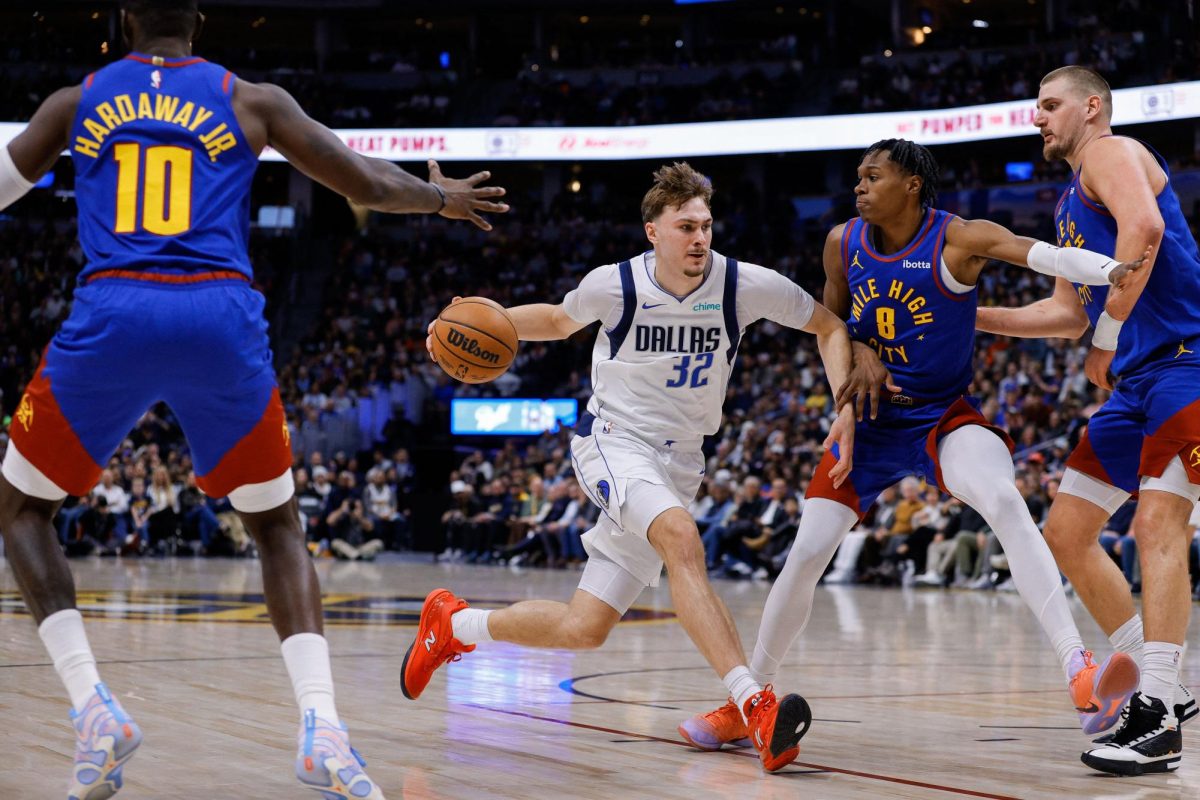
The madness is almost here. College basketball’s top event and one of the most, if not the most, exciting sporting events of the year is soon to gear into action. March Madness 2026 will be played all throughout the nation–both in arenas and in homes. With the help and anticipation of star players like Cameron Boozer (Duke), AJ Dybantsa (BYU), Sarah Strong (UConn) and Audi Crooks (Iowa State), the stage is set for jaw dropping plays, emotional wins and defeats, shocking upsets, and three weeks of pure unpredictable hoops.
Each spring, the NCAA Division I Men’s and Women’s Basketball Tournaments, better known as March Madness or “The Big Dance,” brings together 68 of the best college basketball teams in the country to compete for one main goal: a national championship. March Madness is a single elimination tournament, meaning if you lose, you go home, and consists of seven rounds: the First Four, the First Round, the Second Round, the Sweet Sixteen, the Elite Eight, the Final Four, and the National Championship.
There are four regions within the bracket, with teams in their respective regions being seeded from the one seed, all the way down to the 16 seed. The higher seeded teams are selected based on their statistics and record are usually the better overall teams. In 2026, The Big Dance will begin on March 17, starting with the First Four, and will run through the semifinal games on April 4th and the championship game on April 6th.
The tournament will be played in numerous locations, including Buffalo, New York, Oklahoma, Philadelphia, and more. The Final Four and National Championship will be played at one location: Lucas Oil Stadium in Indianapolis, Indiana.
March Madness has come a long way from its origins. The first NCAA Division I Men’s Basketball Tournament was played in 1939. It consisted of only 8 teams, with Oregon beating Ohio State for the title. March Madness eventually grew from 8 to 16 teams in 1951, then doubled to 32 in 1975, and ultimately expanded to the current 64 teams in 1985.
As for the NCAA Division I women’s bracket, the first tournament was played in 1982, consisting of 32 teams, with Louisiana Tech taking down Cheyney State in a 76-62 win for the title. The women’s tournament would go on to adopt the 64-team field format in 1994. Over the years, a variety of different schools have come out on top. The recent winners of the Men’s Bracket are Florida (2025), UConn (2024, 2023), Kansas (2022), and Baylor (2021). The Women’s Bracket was recently won by UConn (2025), South Carolina (2024), LSU (2023), South Carolina (2022), and Stanford (2021). The opening favorites to win the tournament this year are Arizona, Michigan, and Duke for the men’s, and UConn, UCLA, and South Carolina for the women’s.
However, as many people know, March Madness is not solely about basketball. One of the most culturally prevalent aspects of March Madness is the long-standing tradition of filling out brackets in hopes of predicting the correct outcome of every game out of the 67 total games. “I make a bracket every year,” Karlis McBride ’26 says. Players can go to sites like ESPN, NCAA.com, CBS Sports, and Yahoo to find a bracket to fill out, and can even play with friends or strangers on the same platform to further the competition.
Religious Studies Co-Department Head Mr. Scott McDade created a school-wide bracket group. He said March Madness brackets are “something that I had done since I was in high school on paper. When I started teaching, I would do it with my classes, and it’d be like, we’re gonna play for fun, but extra credit for whoever finishes first. I saw that it was a way, especially for freshmen, to get to know each other.”
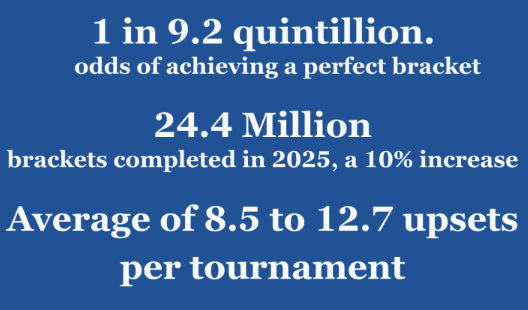
However, making a bracket is certainly not as easy as it may seem. There has never, in the history of March Madness, been a verified perfect bracket. This may come as a surprise, but the odds of achieving a perfect bracket are approximately 1 in 9.2 quintillion.
McDade says, “It is the most teams in the shortest period of time, and you’ve got the biggest delta between the number one ranked team playing a team that you’ve never heard of before, and you get these insane upsets.” The closest a bracket has ever gotten to being perfect was in 2019, when an Ohio man named Gregg Nigl correctly predicted the first 49 games of the tournament. Chances are so slim that prizes over the years have turned into one million dollar or even one billion dollar prizes.
When filling out their brackets, players use many different strategies to choose a team. McDade says, “I make multiple ones every year. Strategy depends on the size of the league and the rules of the league. In the teacher’s league, which is, you know, not too big, it’s small enough that you have to kind of pick a favorite to win in order to try to win, but in the school one, you have like a 100 plus people, and I could be like, you know what? I’m going for the Dayton Flyers,”a team that can be seen as an underdog or Cinderella story pick.
McBride ‘26 said, “I usually look at some stats but also trust my gut on a few games. You can’t just guess everything, but you also can’t pick all favorites because there are always crazy upsets.”
Despite the slim odds of getting a perfect bracket, this tradition keeps growing in popularity. ESPN cited a new record, 24.4 million completed brackets in 2025, a 10% increase from the 2024 record of 22.6 million brackets. And who knows, out of all those brackets, maybe this year could be the year where one very lucky winner, possibly even you, achieves this historic feat.
March Madness certainly has a deep and interesting history, unbelievable prizes, and fun tournament challenges, but what actually makes this tournament so special? In short, what separates it from the other tournaments is its unpredictability and the opportunity for really any team in the tournament to make a run and win it all.
McBride ’26 says, “March Madness is special because it’s single elimination, so one bad game and your season is over. Anyone can win, and underdog wins happen every year, making it unpredictable and exciting.” School accomplishments, coach accolades, star players, or school prestige all have the potential to go out the window. The single-elimination format creates immense pressure, which some teams feed off of, and others crumble under. This leads to dramatic upsets and unbelievable buzzer beaters that can turn a not-so-well-known team or player into a national sensation overnight.
Everyone loves a good underdog Cinderella story, and that narrative frequently occurs in March Madness. According to NCAA.com, there has been an average of 8.5 to 12.7 upsets per tournament (where a lower seed defeats a higher seeded team), with there being at least 10 upsets in 15 of the past 39 seasons.
March Madness is also a very emotional time. McDade says, “College and the college game, people, and those athletes, they’re still kids in a way, you know, with big swings of emotion.” That youthful energy, along with the players’ knowledge that this may be their only real chance to win a national championship, is what makes this tournament so intense.
On top of basketball, the bracket making and the competition within them have actually turned into a great way to foster community. McDade says, “It feels like both a sporting event and a social event. I walk into the lunchroom in the cafeteria, and it’s on the screen there, and people are just going insane over the most random team they’ve never watched in their lives winning a last second buzzer beater. Everyone’s celebrating and high-fiving, or they’re upset, because their team lost, and that is just so much fun.” The madness is real, and many around the country could not be more excited to see what March Madness has in store for 2026.