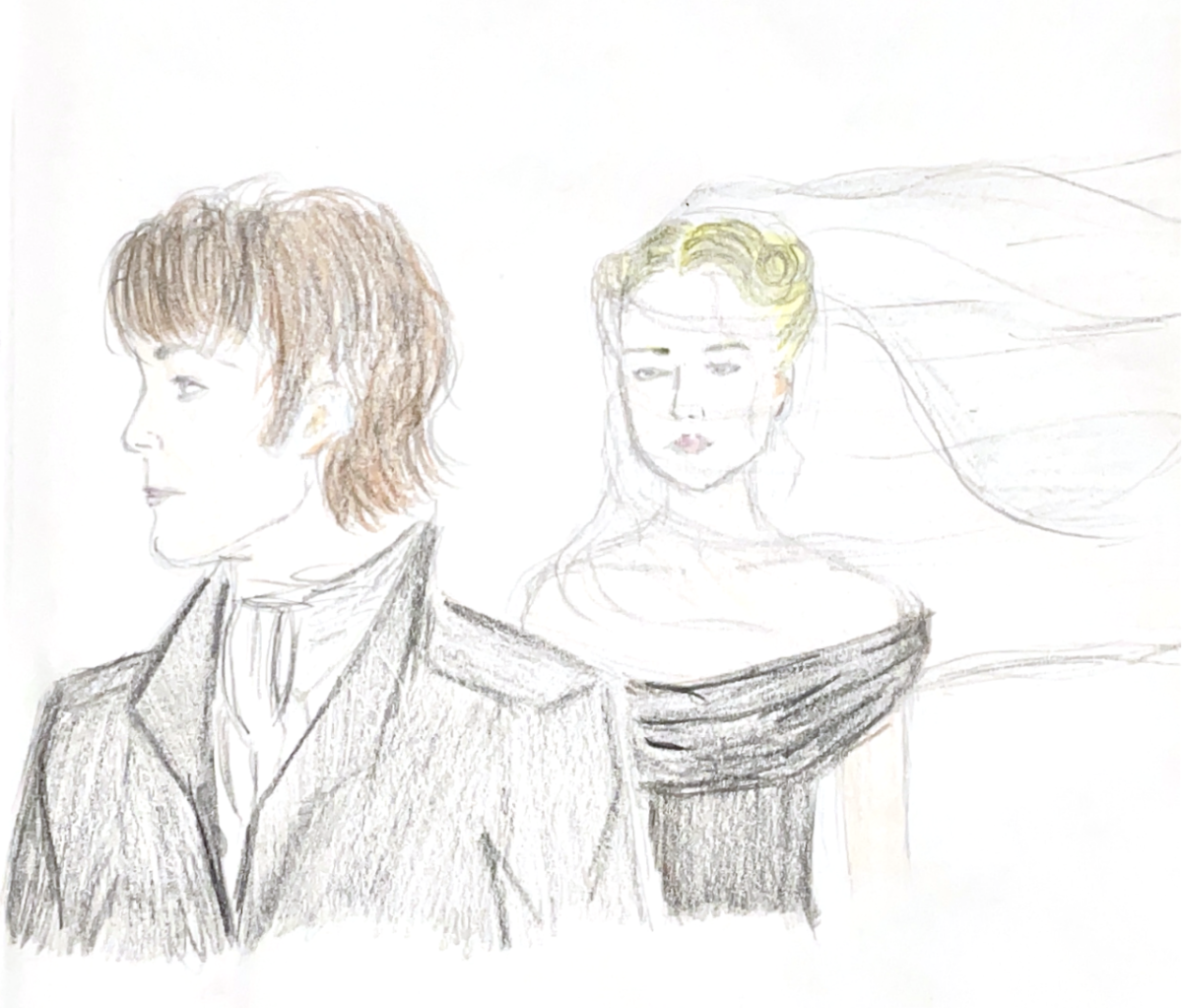
Director Emerald Fennell’s new film adaptation of “Wuthering Heights” arrives with a kind of aesthetic confidence that makes its intentions immediately clear: this will not be a restrained literary adaptation, nor will it apologize for its excess. The film, released strategically on Valentine’s Day, is lush, saturated, and almost aggressively tactile. Rain clings to fabric, corsets constrict, and rooms glow in lacquered reds and candlelit gold. Margot Robbie’s Cathy and Jacob Elordi’s Heathcliff move through this world with a volatile magnetism that feels less like Victorian realism and more like the daydreams of an admirer of the era. From the outset, the film is not book-accurate. It is also, in many respects, undeniably enjoyable to watch.
Fennell understands how to construct landscapes. The moors are not merely bleak stretches of land but operatic landscapes, spaces that seem to expand and contract with the emotional intensity of the characters. Thrushcross Grange, reimagined with striking stylization, becomes less a historically grounded estate and more a psychological environment—glossy, heightened, and faintly surreal. The film moves with a deliberate sensuality, leaning into the physicality of longing rather than leaving it implied. In doing so, it creates something immersive and truly cinematic in the fullest sense of the word. Yet, immersion is not the same as adaptation.
Emily Brontë’s novel is not simply a story of grand, ill-fated love. It is a study in obsession that corrodes not only two individuals but entire generations. It is concerned with class hierarchy, inheritance, and social exclusion. Heathcliff’s outsider status—repeatedly emphasized in racially and socially charged terms—is foundational to his character, and is cultivated through humiliation and exclusion. Cathy’s choices, likewise, are acts embedded within a rigid social structure that values status over authenticity. The novel insists that personal passion and structural cruelty cannot be disentangled. Fennell’s adaptation pares this framework down.
In the novel, the story continues past Cathy and Heathcliff, following their respective children, through whom Heathcliff extends his revenge, manipulating marriages and inheritance to consolidate power. In the film, this second generation is excised entirely. The framing narrative disappears. Hindley, Cathy’s brother, whose descent into alcoholism and debt allows Heathcliff to take control of Wuthering Heights, is removed from the plotline. What remains is the central dyad, Cathy and Heathcliff, intensified, aestheticized, isolated from the broader systems that shaped them. This narrowing signals the crucial shift Fennell made, from an emphasis on social tragedy to romantic combustion. The film treats their connection more as an elemental force, something self-contained and inevitable.
There is a certain logic to this approach. Fennell appears less interested in reproducing Brontë’s structural complexity than in capturing the sensation of encountering the novel for the first time: the overwhelming intensity, the sense that these two characters are bound beyond reason. But by softening the novel’s engagement with racial ambiguity and class hostility, the film subtly alters the weight of Heathcliff’s vengeance. Similarly, when Cathy’s sharper, more calculating edges are smoothed into sympathetic vulnerability, the narrative shifts from mutual destruction to tragic inevitability.
None of this renders the film unsuccessful. On the contrary, it succeeds entirely, only at a different goal than was expected: to commit fully to an interpretation that prioritizes spectacle, compelling performances, and design over narrative, while still paying respect to the masterpiece that inspired it. This is the film’s internal logic, and within that logic, it functions. It is, after all, “Wuthering Heights,” with an emphasis placed on the quotation marks around the title. Even Fennell herself can acknowledge that accuracy is not a goal of her production.
An adaptation is not obligated to replicate its source material verbatim, nor should it be. But when a work so beloved and so deeply invested in social and psychological architecture is reduced to its most operatic elements, the result inevitably reshapes its meaning. Fennell’s “Wuthering Heights” can stand on its own as a bold, visually sophisticated film that understands how to capture the emotion Brontë’s narrative incites. However, it must not be mistaken for that narrative itself.
To watch it expecting the novel is to invite disappointment. To watch it as a stylized reinterpretation—a work that borrows characters and atmosphere while discarding structure—is to recognize its strengths without overstating its achievement. On its own, “Wuthering Heights” is a beautiful, engaging film, but one that certainly needs to be evaluated independently of its source material.