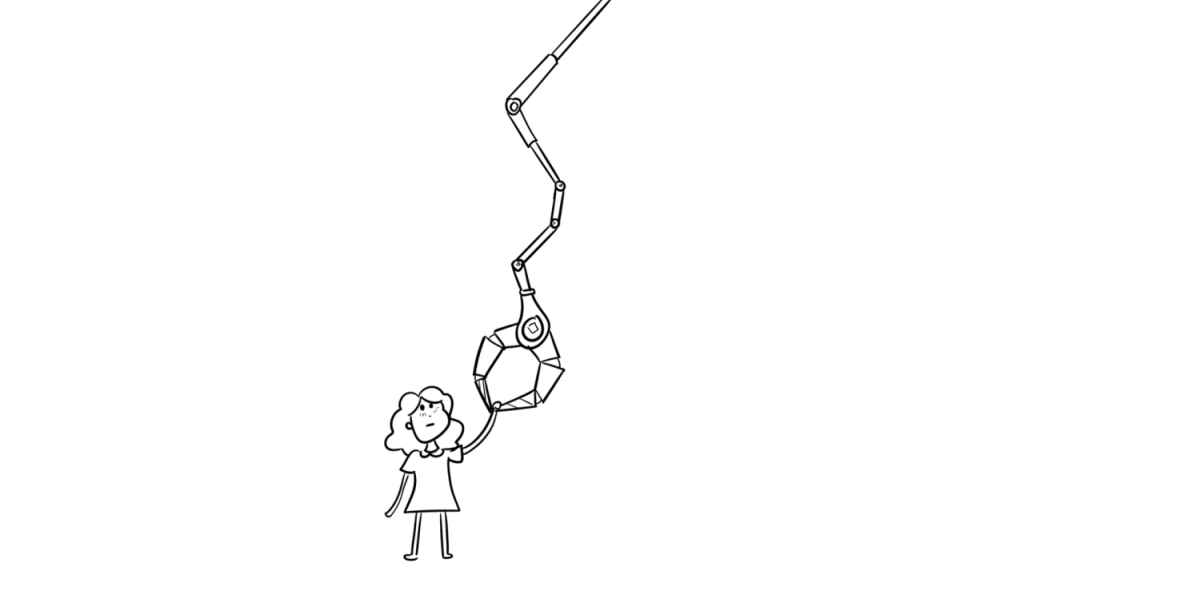
Imagine a ten-year-old scrambling to finish their science project, dreading a book report, or staring at a blank page for an art assignment—and instead of stepping up to the challenge, they just shrug and ask a robot to do it. It seems unreal when you think about it, right? The idea of kids relying on robots to tackle their responsibilities sounds straight out of a sci-fi movie, but scarily enough, this is our everyday reality. Today’s kids are growing up with artificially intelligent technology as a constant presence within their lives—from bots that answer questions right away to apps that can make music, art, and stories given nothing but a singular prompt. Watching my 10-year-old sister navigate this world has made me realize how different her childhood experience is from mine due to these technological advances.
Artificial intelligence is everywhere, particularly in school settings, making its impact hard to ignore. I notice students, including myself, use tools like ChatGPT to brainstorm ideas, study for tests, or help understand a certain topic. Since nearly every class assignment is on a device, it is hard to resist using AI as a shortcut. It just seems easier. Gigi Castaillac ‘28, when explaining how AI helps her writing process when she is stuck, says, “I use [AI] for inspiration. I’ll give it the prompt and then take inspiration from what it gives me.” However, Gigi also approaches the topic with caution, saying that even though AI is helpful, “sometimes it gives fake information … it can’t be trusted for factual stuff.” Gigi’s comments demonstrate how students are questioning how reliable AI really is, emphasizing that the challenge now isn’t whether to use technology, but navigating how to use it responsibly.
The positives are clear. AI can make information more accessible, give new perspectives, and spark curiosity in students, especially when another form of help is not present. English and Health/Wellness Teacher Mr. Douglas Hosking described using AI in class to help explain the complex topic of spatial theory, demonstrating that AI is helpful for clarifying abstract concepts for students. Even though Hosking supports the use of AI in his classroom, he has clear concerns about its potential to replace personal effort. He says, “If a thing should be struggled with by people, it shouldn’t be engaged with using AI,” stressing the importance of letting students wrestle with challenges that truly build critical thinking and application skills. Overusing AI can unintentionally stunt students’ growth by taking away opportunities that could let them challenge themselves. When every answer is handed to them, they miss the chance to experiment, make mistakes, and learn from them.
We should treat AI as a partner instead of a replacement, using it in a way that sparks creativity rather than hinders it. Students should use AI for ideas, feedback, and new approaches, but they need to supplement this with critical thinking, major decisions, and content. Teachers, parents, and peers can guide students to use AI responsibly by setting clear boundaries, modeling how to verify AI-generated information. Students need to learn that individual reflection on how AI is used in their lives is essential for academic and personal success.
Hosking also raised concerns about using AI as a shortcut from a wellness perspective. Adolescents are especially vulnerable due to an “imbalance between the amygdala,” which drives emotions and the “still-developing prefrontal cortex,” which governs judgment. This makes teens more likely to misuse AI or form unhealthy attachments, especially when it mimics emotional support. Because adolescence is one of the most important stages of brain development (second only to infancy), it is critical for developing identity, independence, and mental habits. If AI takes away too many opportunities for problem-solving and self-discovery by offering an answer to every question, it could hinder the development of kids into adulthood. These risks are why careful guidance is crucial in schools and at home.
The stakes for using AI responsibly are high. Teens are at a stage where guidance can make the difference between technology being a tool for growth or being a shortcut that limits learning. So, where do we draw the line? It isn’t about banning AI or technology entirely, but about finding ways to use them thoughtfully. As Hosking explains, “A question of how to best give students access to those skills and the capacity to learn those skills using the technology we have.” When approached this way, AI doesn’t replace learning but enhances it, helping students develop the creativity, independence, and judgment they’ll need to navigate an increasingly digital world.