Why are Fantasy Football Leagues so Popular?
Trevor Lim ‘27 – Staff Writer
Every fall, millions of users eagerly draft teams, dispute over trades, and cheer on their players in hopes of winning their fantasy football league. From the thrill of the competition and strategy, to the relationships and communities it fosters, fantasy football continues to make its case as one of the best sports games out there.
What is Fantasy Football?
Fantasy football is an online game that allows users to step into the role of a general manager, building teams make up of real NFL players. It is a game of fun and strategy, as one must use their knowledge to predict which players will score the most, who they should pick up off waivers, who they should trade for, etc. A standard fantasy football lineup consists of a quarterback (QB), two running backs (RBs), two wide-receivers (WRs), one tight end (TE), one flex — either a RB, WR, or TE — one defensive player, and one kicker. Fantasy has expanded onto various platforms, with the two most common being ESPN and Yahoo, along with various others such as Sleeper, NFL Fantasy, and more.
For each week of the 18-week-long NFL season, real-life NFL players can earn points for their fantasy owners based on how well they perform in actual games. The points each position can earn are different, and they relate to what the player’s responsibility is on the field. For example, a quarterback may earn points for throwing a touchdown pass, while a running back may earn points for rushing yards. In general, offensive players mainly score points by either passing, rushing, or receiving, and defensive players score points through interceptions, sacks, blocked kicks, and fumble recoveries.
Managers (players) compete against each other with one goal: to win the championship. The average fantasy football regular season is approximately 14 weeks, with weeks 15, 16, and 17 reserved for the fantasy football playoffs. Many users and leagues around the world get creative with their punishments for the loser, adding a little extra spice and pressure to the game. The fantasy football world has seen ridiculous punishments including the milk mile (running a mile and having to chug a gallon of milk each lap), signing up to perform unprepared at a comedy show, and making TikToks (usually very embarrassing). In short, don’t lose the league.
Why is Fantasy Football so popular?
ESPN Fantasy Football, “the No. 1 most popular fantasy football game, has set another all-time record this season with more than 14 million fans playing the game.” How is it possible that Fantasy Football leagues have reached such popularity?
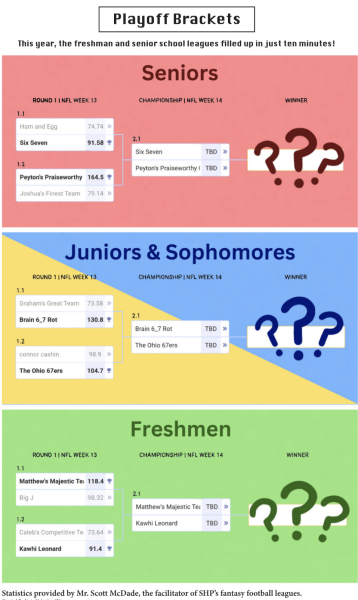
For one, it allows users to follow the NFL more closely. Even in games that don’t involve their favorite team, users can still find significance and entertainment when their fantasy players are on the field. Scott McDade, Religious Studies Co-Department Head, is a fantasy football enthusiast running multiple leagues schoolwide. When asked about the rise of fantasy football, he said “It’s a way to make all the games meaningful to you. It makes you care more, so you’re more invested in football and the NFL.” Throughout the process of deciding which players to start, trade, drop, or add, users can learn more about players they most likely never knew about, ultimately making them more knowledgeable and up to date within the NFL as a whole.
Another huge reason for fantasy’s popularity is that users get to feel like a GM (general manager) for an actual team. Aeden Dortrait ‘27 says, “I think the importance of fantasy football is being able to put yourself in the situations of others. I mean, you have players, coaches, and GMs, who go through a lot on a day-to-day basis, and I think fantasy football helps us connect to them on a deeper level, and put ourselves in their shoes, which is something I love about it.” In real life, becoming a general manager or even obtaining a high-level sports position/job can be very difficult, but fantasy football allows users to have that within seconds.
Beyond the strategy, the statistics, and the competition, one of the driving forces behind fantasy football is its social impact. When asked about the effects of fantasy on the school community, McDade said, “In just the community of my classes, every single class, before class starts, at least one or more students ask me [to] show the results from the week.” He also offered an interesting point, saying how “it gets people to sort of talk to each other and interact with each other, mostly with freshmen. With 1st semester freshmen, for some of them, this might be one of the only ways that they, in a really kind of low stakes, safe way, get to interact with other freshmen, and then make friendships.”
This social level impact is also evident from a student’s perspective. Dortrait says, “Obviously, I talk to my friends about other things, but I feel like sometimes when I just want to chillax and talk to my friends about something other than life and school, I feel like fantasy football is a way to step away from all that. It helps cultivate better relationships with my friends that will last a long time.” Friends, classmates, teachers, coworkers, or even strangers can bond and connect through fantasy football. Having a shared topic of conversation can greatly influence and develop relationships.
For millions of fans, fantasy football is a hobby, a tradition, and something to look forward to. If fantasy football continues providing entertainment, excitement, competition, and knowledge, it will only continue to grow bigger and bigger.